

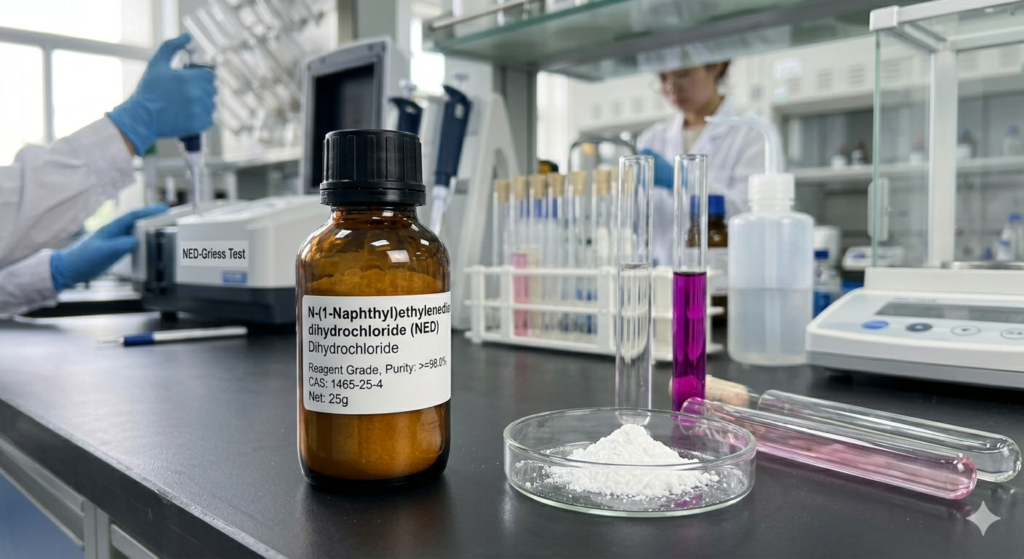
N-(1-Naphthyl)ethylenediamine Dihydrochloride (NED): A Key Analytical Reagent
N-(1-Naphthyl)ethylenediamine dihydrochloride, frequently abbreviated as NED or NEED, is a vital organic reagent primarily used in colorimetric chemical analysis. It is most widely recognized for its role in the Griess test, a standard method for detecting and quantifying nitrites and nitrates in various samples, including water and biological fluids.
Chemical Profile and Properties
NED is an organic compound typically available as a high-purity dihydrochloride salt.
- Chemical Formula: $C_{12}H_{14}N_2 \cdot 2HCl$
- Molecular Weight: 259.18 g/mol
- CAS Number: 1465-25-4
- Appearance: White to off-white or light pink crystalline powder
- Solubility: Soluble in water (approximately 30 g/L at 20°C) and 95% alcohol; slightly soluble in acetone and absolute alcohol
- Stability: This compound is highly light-sensitive and will darken progressively upon exposure to light, especially sunlight.
Primary Applications
NED’s versatility makes it indispensable in both clinical and environmental laboratory settings.
1. The Griess Test (Nitrite/Nitrate Analysis)
In the Griess reaction, NED acts as a coupling agent. When a sample containing nitrite is treated with sulfanilamide under acidic conditions, a diazonium salt is formed. NED then reacts with this salt to produce a bright magenta or red azo dye. The intensity of this color is measured spectrophotometrically (typically at 540 nm) to determine the concentration of nitrite ions.
2. Environmental Water Quality
Environmental scientists use NED to monitor nitrogen levels in wastewater and natural water bodies. It is essential for ensuring water safety and tracking industrial or agricultural runoff.
3. Biochemical and Plant Research
NED is used in assays to demonstrate the induction of nitrate reductase in plants. It is also employed in the quantitation of sugars when dissolved in a sulfuric acid-methanol solution.
4. Pharmaceutical Analysis
The reagent is utilized in the quantitative analysis of sulfonamides in blood and other clinical samples, providing critical data for medical diagnostics.
Safety, Handling, and Storage
While essential for research, NED must be handled according to strict safety protocols.
- Hazard Classification: Classified as an irritant. It can cause skin irritation, serious eye irritation, and respiratory irritation if dust is inhaled.
- Personal Protection: Laboratory personnel should wear protective gloves, safety goggles, and long-sleeved clothing. Use in a well-ventilated area or under a fume hood to avoid breathing dust.
- Storage Conditions:
- Store in light-resistant (amber) containers to prevent degradation.
- Keep containers tightly closed in a cool, dry, and well-ventilated place.
- Protect from moisture (hygroscopic) and keep away from strong oxidizing agents and strong alkalis.
Quality Standards
For accurate analytical results, laboratories often require ACS Reagent Grade NED, which meets the stringent specifications of the American Chemical Society. High-purity versions (≥98% assay) ensure that baseline interference is minimized during sensitive colorimetric assays.
While they are related compounds, 4-Aminoantipyrine features an amino group at the 4th position of the pyrazolone ring. This specific structural modification makes it highly reactive for the oxidative coupling used in colorimetric assays, whereas standard Antipyrine was historically used more for its analgesic properties.
NED is highly light-sensitive. Exposure to light, especially direct sunlight, causes the compound to darken progressively and degrade. Storing it in light-resistant amber containers ensures the chemical stability and accuracy of the reagent for laboratory use.
No. Both 4-Aminoantipyrine and NED are laboratory-grade chemical reagents intended for professional use in controlled environments. They are not formulated or safety-cleared for DIY medical testing or domestic use.
When NED is used as a coupling agent in the Griess reaction, it reacts with diazonium salts to produce a distinct magenta or red azo dye. The intensity of this color change is measured to determine the concentration of nitrites in the sample.
High-purity 4-Aminoantipyrine typically appears as a light yellow to tan crystalline powder. While a slight tan hue is normal, extreme darkening or a deep brown color may indicate oxidation, which can lead to inaccurate baselines and reduced sensitivity in assays
NED is classified as an irritant that can affect the skin, eyes, and respiratory system. Protective equipment—including gloves, safety goggles, and lab coats—should always be worn, and the chemical should be handled in a well-ventilated area to avoid inhaling dust.
In the presence of an oxidizing agent and an alkaline solution, 4-Aminoantipyrine reacts with phenolic compounds to form a bright red or orange dye. This “4-AAP Method” allows environmental scientists to detect industrial pollutants at very low concentrations.
Yes, NED is soluble in 95% alcohol and slightly soluble in absolute alcohol. It is also soluble in water at approximately 30 g/L at 20°C.
Using high-purity chemicals, such as ACS Reagent Grade, is essential to minimize “background noise” and prevent false-positive results in sensitive diagnostic or environmental tests. Impurities can compromise the stability of the reagent and the reproducibility of your data.
Leading technical suppliers like Brand Chemical Supplies provide a wide range of laboratory-grade chemicals, specializing in industrial fluid management, laboratory research, and biotechnology development.
