

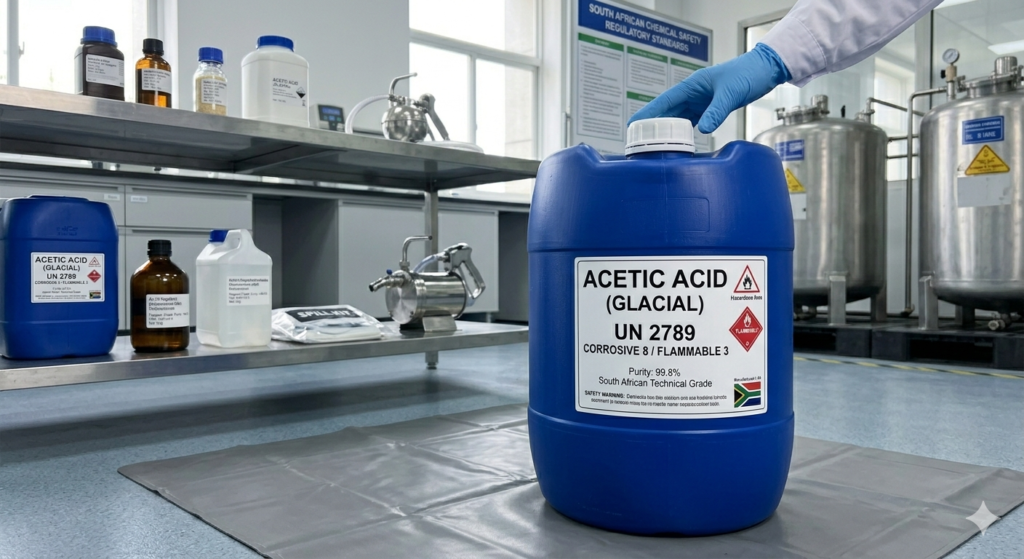
The Ultimate Guide to Glacial Acetic Acid: Properties, Uses, and Safety Protocols
Acetic acid is one of the most recognizable chemical compounds in the world. In its household form—vinegar—it is a staple of kitchens and cleaning cabinets. However, in its purest, most concentrated form, it is known as Glacial Acetic Acid (GAA), a powerful and versatile industrial reagent with applications ranging from pharmaceutical synthesis to textile manufacturing.
For industrial professionals and laboratory researchers, particularly those operating in the South African commercial market, understanding the technical nuances of this compound is essential for both operational efficiency and regulatory compliance.
1. What is Glacial Acetic Acid?
The term “glacial” refers to the anhydrous (water-free) state of acetic acid, typically available in concentrations of 99.5% to 100%.
Why is it called “Glacial”?
The name is derived from the compound’s unique physical property: it freezes into ice-like crystals at 16.6°C (61.9°F). Since this temperature is only slightly below typical room temperature, the acid can often solidify in storage during cooler months, resembling a block of ice or a “glacier”.
Key Chemical & Physical Properties
- Molecular Formula: $CH_3COOH$ or $C_2H_4O_2$
- Molecular Weight: 60.05 g/mol
- CAS Number: 64-19-7
- Appearance: Clear, colorless liquid with a pungent, biting odor
- Boiling Point: 117.9°C
- Acidity: While classified as a weak acid in terms of its dissociation in water, it is highly corrosive in its glacial state.
2. Industrial and Laboratory Applications
Glacial Acetic Acid is a fundamental “building block” chemical. Its versatility stems from its ability to act as a solvent, an acidulant, and a precursor for other chemical reactions.
A. Chemical and Polymer Production
The largest global use of GAA is as a precursor for Vinyl Acetate Monomer (VAM). VAM is the key ingredient in:
- Adhesives and Glues: Including common wood glue (PVA).
- Paints and Coatings: Providing durability and flexibility.
- Textiles: Used in the production of synthetic fibers.
B. Food and Beverage Industry
In the food sector, acetic acid acts as a preservative and flavoring agent.
- Acidulant: It provides the characteristic “tang” in sauces, dressings, and pickles.
- Decontamination: It is used for the microbial decontamination of meat products.
- Acidity Regulator: It helps maintain the pH balance necessary for food safety and shelf-life.
C. Pharmaceutical and Medical Uses
While undiluted GAA has no direct medical use, it is a vital starting material for:
- Drug Synthesis: It is used in the manufacture of common medications like aspirin (acetylsalicylic acid).
- Diagnostics: Diluted solutions (usually 3–5%) are used in procedures like colposcopy to help identify abnormal cervical tissue.
- Irrigation: Very low concentrations (0.25%) are used for bladder or wound irrigation to prevent infection.
Warning: Improper dilution of GAA in medical settings has historically led to severe chemical burns. Always verify concentrations before clinical use.
D. Textile and Dye Industry
In textile manufacturing, GAA is used to neutralize alkaline solutions and as a mordant in the dyeing process, helping colors “fix” to the fabric.
3. Safety and Hazard Identification
Because Glacial Acetic Acid is highly concentrated, it poses significant risks if not handled with professional care. According to the Globally Harmonized System (GHS), it carries the following classifications:
- Flammable: Liquid and vapor can ignite if exposed to heat or sparks (Flash point: ~39°C).
- Corrosive: Causes severe skin burns and permanent eye damage.
- Respiratory Irritant: Inhaling concentrated vapors can cause suffocating sensations and damage to the mucous membranes.
Required Personal Protective Equipment (PPE)
When working with GAA, the following equipment is mandatory:
- Chemical-resistant gloves (Nitrile or Butyl rubber).
- Safety goggles or a full-face shield.
- Laboratory coat or acid-resistant apron.
- Fume hood: Concentrated GAA should only be handled in a well-ventilated space.
4. Proper Handling and Storage
To ensure safety in an industrial or laboratory setting, follow these storage protocols:
- Temperature Control: Store above 17°C to prevent the acid from freezing and expanding, which could crack glass containers.
- Material Compatibility: Use corrosion-proof equipment. GAA reacts violently with strong oxidizers, bases, and certain metals (releasing flammable hydrogen gas).
- Grounding: When transferring large volumes, ensure containers are grounded to prevent static discharge, which could ignite flammable vapors.
5. Environmental Compliance in South Africa
For businesses operating in South Africa, the handling and disposal of Glacial Acetic Acid are governed by the Department of Water Affairs & Forestry and the Environment Conservation Act.
- Waste Classification: GAA is classified as a hazardous waste due to its corrosive and flammable nature.
- Disposal: It must never be discharged directly into drains. Disposal must take place at permitted hazardous waste facilities that comply with the “Minimum Requirements” for handling and treatment.
- Regulatory Framework: Compliance with the POPIA (for data) and CPA (for product safety) is standard for chemical suppliers like Brand Chemical Supplies, ensuring that technical data sheets (TDS) and safety data sheets (SDS) are provided to the end-user.
6. Sourcing Quality Glacial Acetic Acid
When your operations depend on chemical precision, the quality of your GAA is paramount. Impurities can lead to:
- Inconsistent Reaction Yields: Affecting the quality of synthetic polymers or drugs.
- Equipment Corrosion: Trace water or contaminants can accelerate the degradation of storage tanks.
- Regulatory Non-compliance: Particularly in the food and pharmaceutical sectors where USP or Food Grade standards are required.
As a leading technical supplier focused on the South African industrial market, Brand Chemical Supplies ensures that all chemical reagents meet rigorous quality benchmarks, backed by professional logistics and delivery expertise across the country.
Conclusion
Glacial Acetic Acid is an indispensable tool of modern industry. While its power demands respect and strict safety adherence, its role in creating everything from the paints on our walls to the medicine in our cabinets is undeniable.
By understanding its properties and maintaining high standards of safety and sourcing, industrial enterprises can harness the full potential of this “ice-like” acid.
Are you looking for high-purity Glacial Acetic Acid for your laboratory or industrial facility? Visit Brand Chemical Supplies to explore our technical catalog and secure reliable delivery today.
