

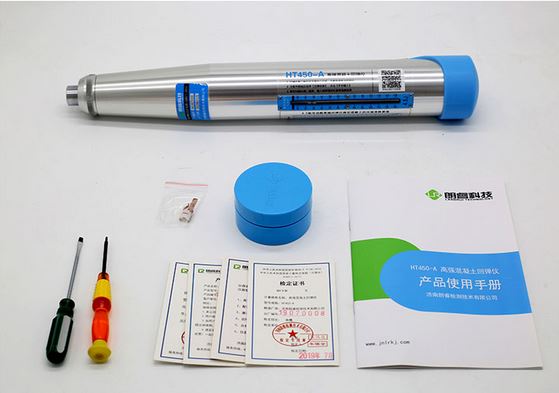
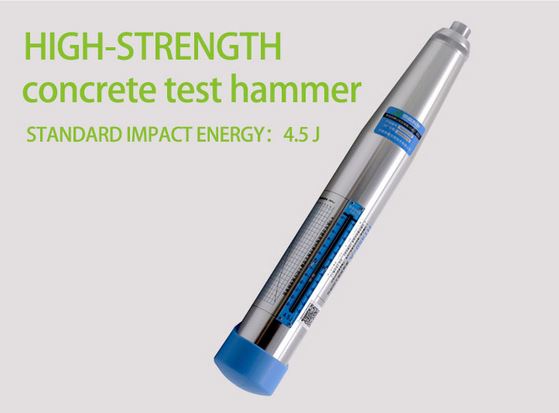
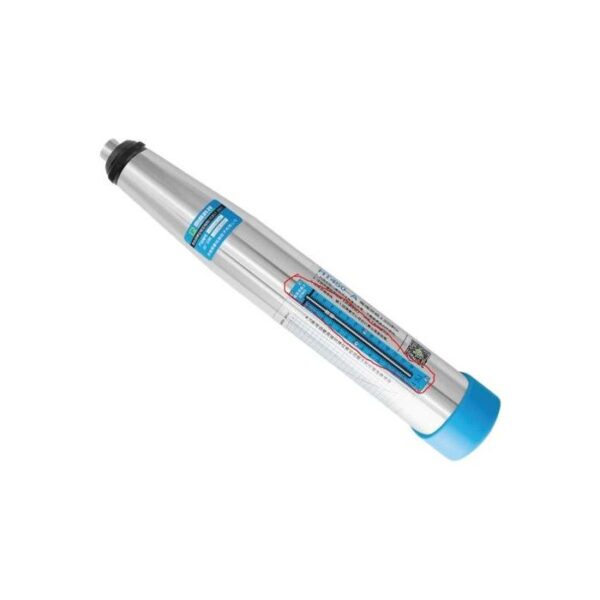
High-Energy Concrete Test Hammer (4.5J / 4.7J)
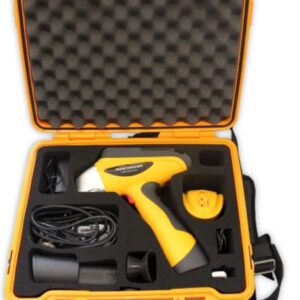
Brand Chemical Supplies provides the High-Energy Concrete Test Hammer, a specialized non-destructive testing (NDT) instrument designed for high-strength concrete applications. While standard hammers operate at 2.207J, this reinforced model provides a higher impact energy—available in 4.5J and 4.7J variants—to accurately assess the compressive strength of high-density structural concrete used in heavy civil engineering and infrastructure projects.
Technical Specifications
| Feature | Specification |
| Impact Energy | 4.5 J \sim 4.7 J (High Energy) |
| Measuring Range | 20 \sim 110 MPa |
| Standards | Compliant with ASTM C805, EN 12504-2 |
| Pointer Length | 20.0 \pm 0.2 mm |
| Spring Tension | 10 \pm 0.5 N/m |
| Dimensions | \Phi 60 \times 350 mm |
| Weight | \approx 2.5 kg |
Key Features & Benefits
-
Extended Strength Range: Unlike standard Schmidt hammers, this high-energy version is capable of testing ordinary to high-strength concrete up to 110 MPa, making it essential for bridges, dams, and high-rise foundations.
-
Non-Destructive Analysis: Allows for the rapid assessment of concrete uniformity and strength without the need for core drilling, significantly reducing testing time and costs on-site.
-
High Durability: Constructed with a high-grade aluminum alloy shell and precision-machined internal components to withstand the rigorous conditions of active construction environments.
-
Direct Readout: Features a clear, high-contrast scale that provides the rebound value (R) immediately. This value is then converted to compressive strength (MPa) using the conversion charts provided with the unit.
-
Consistent Repeatability: The high-tension spring mechanism is calibrated to ensure that every impact delivers exactly the same energy, providing reliable data for structural audits and quality control.
Primary Applications
-
Heavy Infrastructure: Testing the compressive strength of bridge piers, highway overpasses, and airport runways.
-
High-Rise Construction: Verifying the strength of reinforced concrete columns and load-bearing walls.
-
Precast Concrete: Quality checking of large-scale precast segments and railway sleepers.
-
Structural Audits: Assessing the integrity of older concrete structures during renovations or safety inspections.
Best Practices for Testing
-
Surface Preparation: Ensure the test area is smooth, clean, and dry. Use the included carborundum stone to grind away any loose material or paint.
-
Angle of Impact: The hammer should be held perpendicular to the test surface. If testing at an angle (e.g., upwards into a soffit), apply the correction factor provided in the manual.
-
Multiple Readings: Take at least 10 to 12 readings in a small grid. Discard the highest and lowest values and average the remainder for a more accurate representative strength.
-
Calibration: Regularly verify the hammer’s performance using a certified Calibration Anvil (available separately from Brand Chemical Supplies).
Contact our structural testing team at Brand Chemical Supplies today to secure your High-Energy Concrete Test Hammer and ensure your infrastructure projects meet the highest safety standards.


Reviews
There are no reviews yet.