

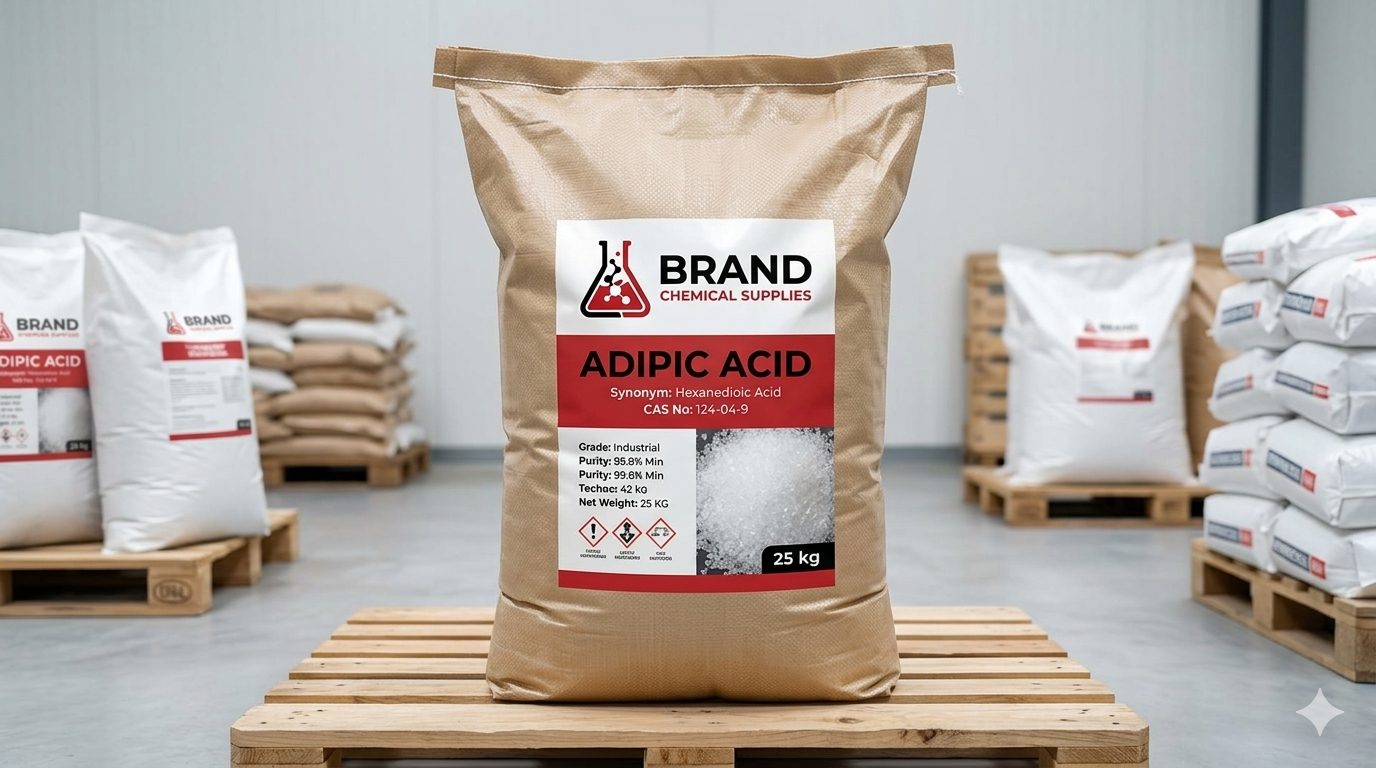
Premium Adipic Acid (Hexanedioic Acid) Supplier | Brand Chemical & Supplies
Brand Chemical & Supplies is a trusted supplier of high-purity Adipic Acid (systematically known as hexanedioic acid). This organic dicarboxylic acid appears as a white, odorless, crystalline solid. Serving as the most industrially vital dicarboxylic acid globally, billions of kilograms are manufactured each year. It functions primarily as a critical chemical precursor for the production of Nylon 6,6, polyurethanes, and high-performance resins.
Request a Bulk Quote Today | Contact Our Sales Team
Technical Specifications & Chemical Properties
The molecular structure of hexanedioic acid features a straight six-carbon chain terminated at both ends by a highly reactive carboxylic acid functional group (-COOH). [1]
-
- Molecular Formula: \(\text{HOOC(CH}_2)_4\text{COOH}\) (or \(\text{C}_6\text{H}_{10}\text{O}_4\))
- Molecular Weight: 146.14 g/mol
- Melting Point: 152.1°C
- Boiling Point: 337.5°C
- Acidity Profile: Dibasic acid (capable of donating two protons to react with two bases)
- Solubility: Highly soluble in alcohol and acetone; only slightly soluble in water
Primary Industrial Applications
As a leading chemical distributor, we supply premium-grade Adipic Acid tailored for multiple commercial sectors:
-
- Polymer & Plastics Production: Approximately 75% of global supply is reacted with hexamethylenediamine to synthesize high-strength Nylon 6,6. It is also a fundamental building block in manufacturing specialized polyurethanes, flexible plasticisers, and synthetic coatings.
- Food Industry Additive (E355): Utilised as a highly controlled acidity regulator and acidulant. It adds a reliable, tart flavor profile to commercial gelatin desserts, powdered drink mixes, jams, and jellies.
- Advanced Formulations: Acts as a performance additive in industrial lubricants, specialized surface coatings, and textile treatment auxiliaries.
Synthesis & Production Methods
We monitor global chemical manufacturing trends to ensure stable supply chains utilizing both conventional and emerging technologies:
-
- Conventional Industrial Synthesis: Traditionally produced via the nitric acid oxidation of a cyclohexanol-cyclohexanone mixture (commonly referred to as KA oil). While highly efficient, modern chemical plants focus on mitigating the nitrous oxide (\(\text{N}_2\text{O}\)) greenhouse gas emissions associated with this petrochemically rooted process.
- Green Bio-Based Synthesis: To meet modern corporate sustainability goals, emerging green methods utilize glucose as a renewable feedstock. Genetically engineered E. coli bacteria ferment glucose into cis,cis-muconic acid, which is subsequently hydrogenated into clean, sustainable adipic acid.
Safety, Handling, & Hazard Information
When sourcing from Brand Chemical & Supplies, ensuring secure site operations is our top priority. Review the summary safety data sheet (SDS) guidelines below:
- Respiratory Hazards: Inhalation of airborne dust causes severe respiratory tract irritation, resulting in coughing and sneezing. Appropriate PPE and dust extraction systems must be used.
- Eye & Skin Contact: Direct exposure poses a severe risk of serious eye damage and irritation.
- Combustibility & Storage: Classified as a combustible solid. Finely dispersed airborne dust particles can form explosive mixtures with air at high temperatures. Store away from open flames, intense heat, and incompatible oxidizing agents

Reviews
There are no reviews yet.